
Are you curious about how AI and automation are changing the world around you? You’re not alone.
As these technologies become more integrated into our lives, understanding their differences and benefits becomes essential. Imagine a future where mundane tasks are handled effortlessly, freeing up your time for what truly matters. That’s the promise of AI and automation.
But how do they differ, and which one is right for your needs? This article will uncover the fascinating world of AI versus automation, helping you make informed decisions for your future. Stay with us as we explore how these powerful tools can transform your personal and professional life, giving you a clearer vision of what lies ahead.
Understanding Ai And Automation
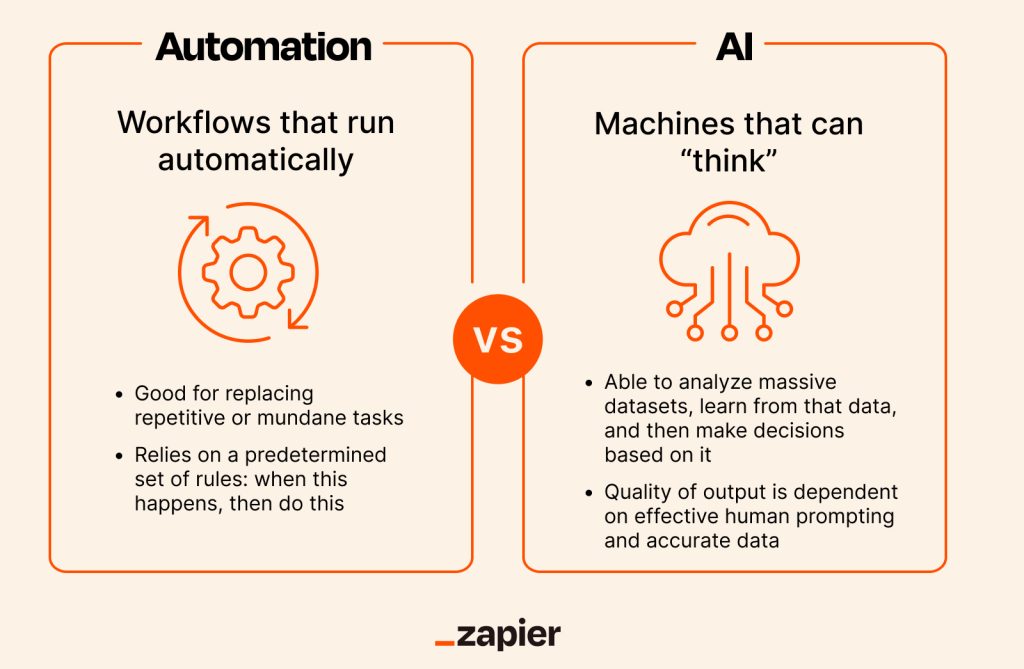
AI focuses on creating smart machines that think and learn like humans. Automation deals with machines performing tasks without human input. AI adapts and improves over time, while automation follows set rules. Understanding their differences helps in utilizing technology effectively.
Understanding AI and Automation In today’s fast-paced digital world, AI and automation are often mentioned in the same breath. Yet, they serve distinct purposes and bring different benefits. As you navigate through these technological advancements, understanding their unique roles can empower you to make informed decisions for your personal and professional life.Defining Ai
Artificial Intelligence, or AI, is a branch of computer science focused on creating systems capable of performing tasks that typically require human intelligence. Think about voice assistants like Siri or Alexa—they learn and adapt to your preferences to provide personalized assistance. AI’s strength lies in its ability to analyze vast amounts of data and recognize patterns. It’s like having a super-smart assistant that can predict your needs before you even realize them. Imagine how this could enhance your daily routine or business operations. AI can also assist in decision-making. For instance, it helps doctors diagnose diseases by analyzing medical images. It’s about enhancing human capabilities, not replacing them.Exploring Automation
Automation, on the other hand, is about using technology to perform tasks without human intervention. Think of it as setting your coffee maker to brew at 7 a.m. every morning. It’s convenient and saves you time. Automation excels in handling repetitive and mundane tasks. Consider a factory assembly line where machines handle the heavy lifting. It frees up human workers to focus on more complex responsibilities. Automation isn’t just for manufacturing. It’s in your everyday life too. Automated emails, online bill payments, and even grocery shopping apps are examples. How could automating tasks streamline your day? Understanding the difference between AI and automation is crucial. AI learns and adapts, while automation executes predefined tasks. Both have their place in making life easier and more efficient. As you explore these technologies, think about where they might fit into your life or business. What tasks could AI improve with its learning capabilities? Which repetitive chores could automation handle, giving you more time for creativity and strategy?Key Differences
In the digital world, understanding AI and automation is crucial. Both play significant roles in technology. Yet, they serve distinct purposes and operate differently. Knowing their key differences helps in applying them effectively.
Ai As A Learning System
AI, or artificial intelligence, mimics human thinking. It adapts and learns from data. AI systems improve over time with new information. They identify patterns and make decisions. AI can predict future outcomes based on past trends. This makes AI dynamic and flexible.
Automation As A Rule-based System
Automation follows set rules to complete tasks. It does not learn or adapt on its own. Automation is about executing repetitive tasks efficiently. It ensures consistency and accuracy by following predefined steps. Automation is static and requires specific instructions.
Impact On Industries
Artificial Intelligence (AI) and automation are changing industries globally. They bring efficiency, accuracy, and new possibilities. This transformation impacts various sectors differently. Understanding these impacts helps in adapting to changes.
Manufacturing Advancements
AI and automation improve manufacturing processes. Machines now handle repetitive tasks. They work faster and with precision. This reduces production time and costs. Factories use AI for quality checks. It detects flaws better than humans. Automation also ensures consistent output. This boosts productivity and meets high demands.
Transformations In Healthcare
Healthcare benefits greatly from AI and automation. AI assists in diagnosing diseases. It analyzes medical data swiftly. This aids doctors in decision-making. Automated systems manage patient records. They ensure accurate and quick access. Robotics in surgery offers precision. It reduces human error and recovery times. AI chatbots provide 24/7 patient support. They answer common health questions.
Retail And Customer Service Innovations
Retail experiences a shift with AI and automation. Automated checkout systems reduce wait times. AI analyzes shopping patterns. It offers personalized recommendations. This enhances customer experience. Virtual assistants handle customer inquiries. They provide quick and accurate responses. Inventory management uses automation. It ensures stock availability and optimizes supply chains.
.png)
Credit: www.moveworks.com
Benefits Of Ai And Automation
AI and automation are transforming how businesses operate. They streamline tasks, enhance efficiency, and reduce human error. These technologies offer many benefits that can elevate business processes. Below, we explore these benefits under specific categories.
Increased Productivity
AI and automation can handle repetitive tasks with ease. This allows employees to focus on more strategic work. Machines work faster than humans, enhancing productivity. Businesses can complete more tasks in less time. This leads to quicker project completion and satisfied customers.
Cost Efficiency
Automation reduces the need for manual labor. This lowers operational costs significantly. AI tools can predict trends and optimize resources. Businesses can save money on unnecessary expenses. Over time, this results in higher profits.
Improved Accuracy
Machines do not tire or lose focus. This means fewer mistakes in tasks. AI algorithms can analyze data with precision. This leads to better decision-making. Businesses can rely on accurate insights to drive growth.
Challenges And Concerns
The rise of AI and automation creates excitement and worry. As these technologies evolve, concerns about their impact grow. Understanding these challenges is crucial for adapting to a changing world.
Job Displacement Fears
Many worry that AI and automation will replace human jobs. Machines can perform tasks faster and without breaks. This efficiency can lead to fewer opportunities for workers. People in repetitive jobs face a higher risk of losing their positions.
Businesses may prefer machines over human labor. The cost savings can be significant. Workers need to adapt by learning new skills. This shift can be difficult, especially for older employees.
Ethical Considerations
AI and automation raise ethical questions. Decision-making by machines can lack human empathy. Algorithms might make choices that harm certain groups. Bias in programming can lead to unfair outcomes.
Transparency in AI processes is essential. Users must understand how decisions are made. Ethical guidelines help ensure fairness. Companies have a responsibility to address these concerns.
Security Risks
Automation and AI systems can be vulnerable to attacks. Cybersecurity threats are a major concern. Hackers may exploit weaknesses in these technologies. Protecting sensitive data becomes a priority.
Companies must invest in robust security measures. Regular updates and monitoring are crucial. The potential for breaches calls for constant vigilance. Security risks cannot be ignored in our digital age.
Credit: www.veryfi.com
Future Trends
Artificial intelligence and automation are shaping the future. They influence various industries and aspects of daily life. Understanding upcoming trends is crucial for businesses and individuals. AI and automation will continue to evolve. They offer new opportunities and challenges. Let’s explore how they impact our world.
Ai In Everyday Life
AI is becoming part of daily routines. Smart assistants like Alexa and Siri help with tasks. They can answer questions and control devices. AI is improving healthcare. Doctors use AI for diagnosing diseases quickly. It enhances education by providing personalized learning experiences. AI-driven apps assist students in learning effectively. Transportation systems are using AI to predict traffic patterns. This helps in reducing congestion and saving time.
The Role Of Automation In Smart Cities
Automation plays a critical role in developing smart cities. It improves infrastructure and services. Automated systems manage traffic lights efficiently. They reduce traffic jams and pollution. Waste management is enhanced through automated sorting and recycling processes. Energy consumption is optimized with smart grids. These grids use real-time data to balance supply and demand. Public safety is increased with surveillance systems. They use automation for quick response to emergencies.
Collaborative Robots
Collaborative robots, or cobots, work alongside humans. They are changing manufacturing and production processes. Cobots handle repetitive tasks with precision. This frees up human workers for complex duties. They are flexible and easy to program. Cobots improve workplace safety. They reduce the risk of injuries. In agriculture, cobots assist in planting and harvesting. They increase efficiency and productivity. These robots are also used in healthcare. They aid in surgeries and patient care.
Balancing Ai And Automation
In today’s rapidly evolving technological landscape, AI and automation are reshaping industries and redefining job roles. Yet, balancing these two forces can be challenging. As you navigate this transformation, it’s essential to understand how AI and automation can coexist harmoniously. Think of them not as rivals but as partners working towards greater efficiency and innovation.
Integration Strategies
Successful integration of AI and automation requires a clear strategy. Consider how each can complement the other. AI can enhance automated processes by adding layers of intelligence and adaptability. Automation, in turn, can handle repetitive tasks, freeing up AI to focus on complex problem-solving.
Start small by identifying processes that can benefit from this synergy. A step-by-step approach allows you to test and refine your strategy, minimizing risks while maximizing rewards. Have you thought about the potential for AI to analyze data generated by automated systems?
Human-ai Collaboration
Human-AI collaboration is crucial for maximizing the potential of these technologies. Imagine AI as a tool that augments human capabilities, not replaces them. By fostering collaboration, you can boost productivity and creativity in your team.
Encourage open communication between humans and AI systems. Training programs can help team members understand how AI tools work, empowering them to leverage these technologies effectively. How can you promote a culture where AI and human skills merge seamlessly?
Policy And Regulation
As AI and automation become more prevalent, policy and regulation play a pivotal role. Governments and organizations must establish guidelines to ensure ethical and responsible use. This involves balancing innovation with the protection of privacy and security.
Stay informed about emerging regulations in your industry. Compliance not only mitigates risks but also builds trust with your stakeholders. What steps are you taking to align your AI and automation initiatives with current policies?
Credit: www.linkedin.com
Frequently Asked Questions
What Is The Difference Between Ai And Automation?
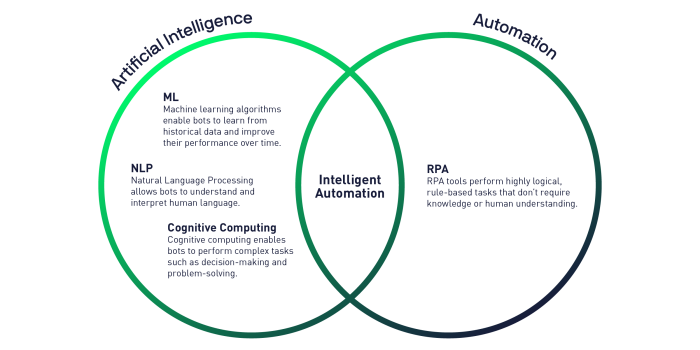
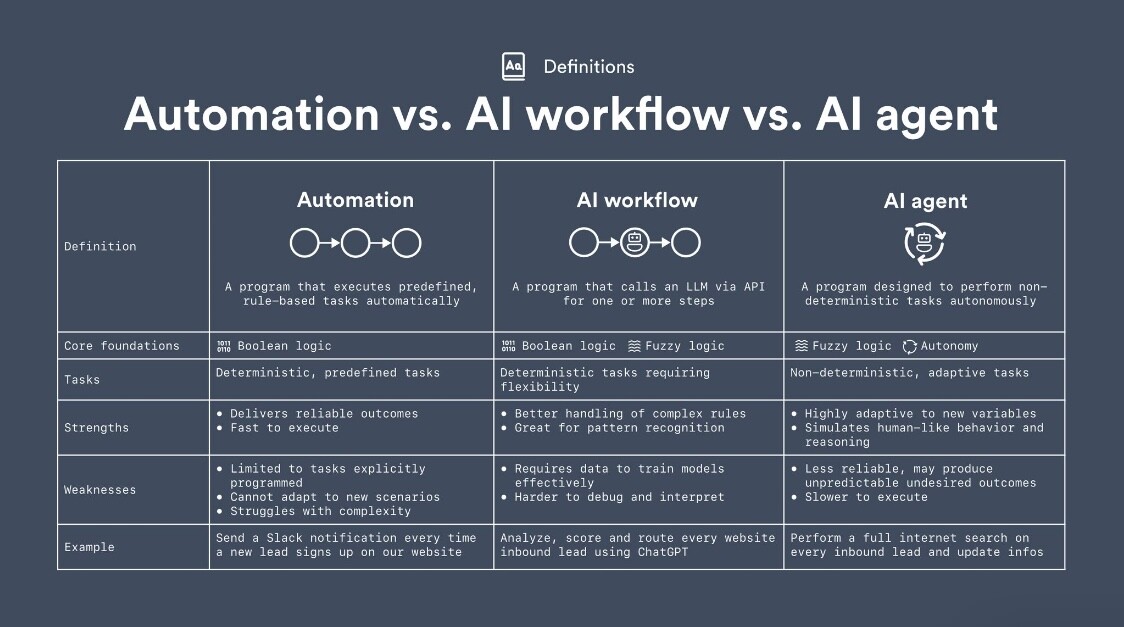
AI involves machines that simulate human intelligence, learning from data. Automation executes pre-programmed tasks without learning. AI adapts, while automation follows fixed instructions. Both enhance efficiency, but AI is dynamic, and automation is static.
Can Automation Be Considered Ai?
Automation is not the same as AI. Automation follows programmed rules. AI mimics human intelligence and learns from data. AI can improve automation by making it adaptive and intelligent. Automation handles repetitive tasks, while AI makes decisions. Both enhance efficiency but serve different purposes in technology.
Is Ai Not Just Automation?
AI is more than just automation. AI involves learning, reasoning, and problem-solving. Automation performs repetitive tasks. AI can adapt, improve, and make decisions based on data. While automation follows predefined rules, AI uses algorithms to simulate human intelligence. AI applications are diverse, from chatbots to data analysis, beyond simple task automation.
Can Ai Replace An Automation Engineer?
AI can assist automation engineers but cannot fully replace them. Engineers offer critical thinking and problem-solving skills. AI lacks the ability to understand complex scenarios and make ethical decisions. Human oversight is crucial for successful automation processes, ensuring safety and efficiency.
Collaboration between AI and humans enhances automation results.
Conclusion
Comparing AI and automation reveals distinct roles. AI learns and adapts. Automation follows set rules without learning. Both improve efficiency but in different ways. AI can handle complex tasks. Automation excels in repetitive tasks. Businesses should choose based on needs.
Understanding these technologies helps make better decisions. Embrace both for maximum benefits. Stay informed as technology evolves. Balance between AI and automation ensures success.
